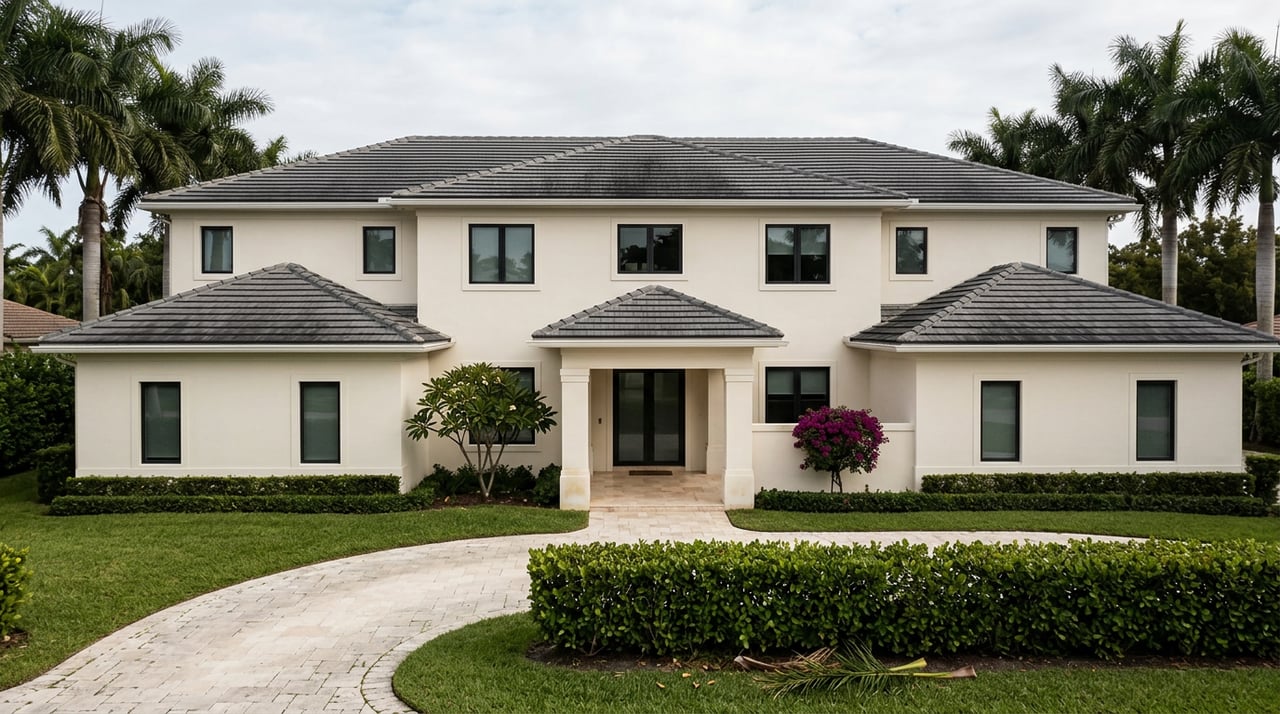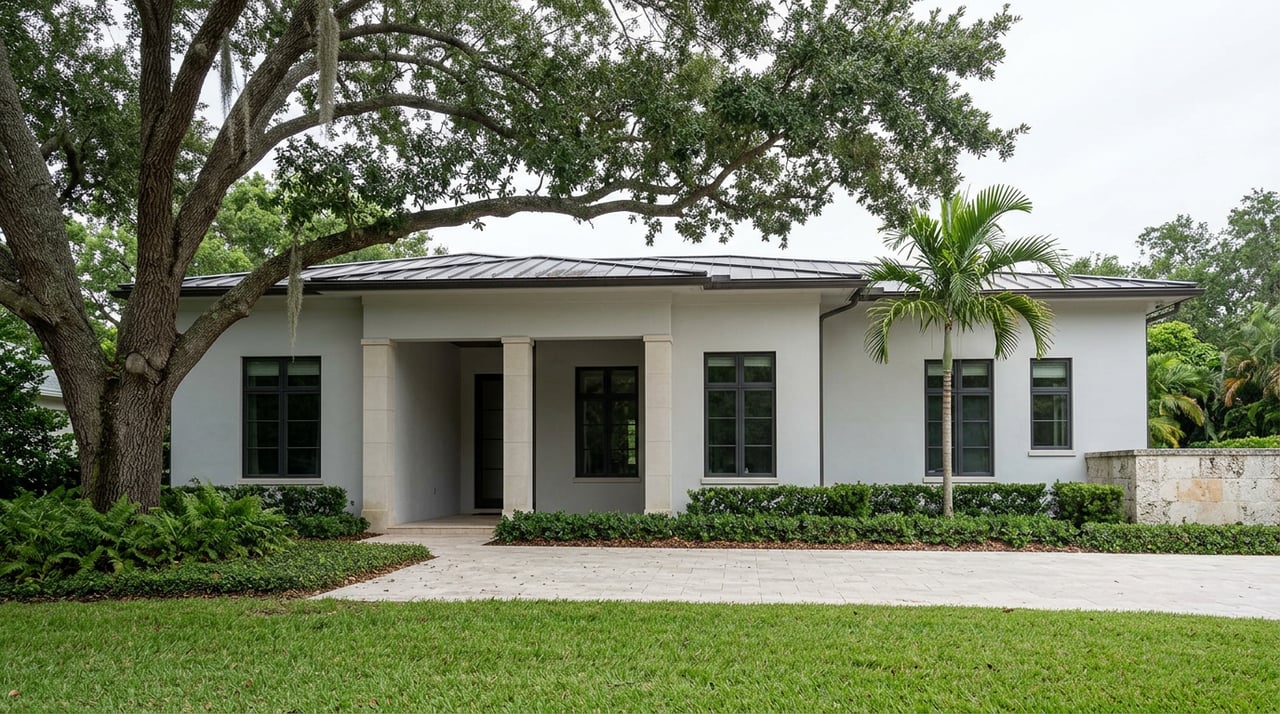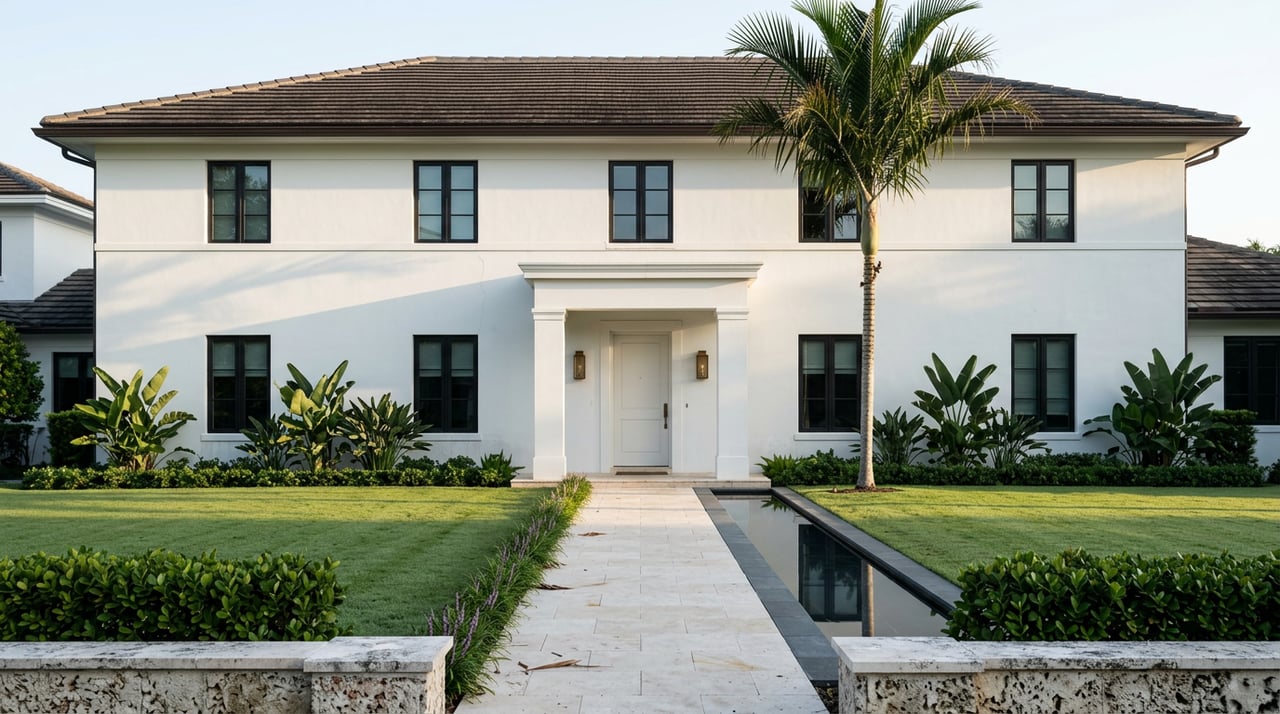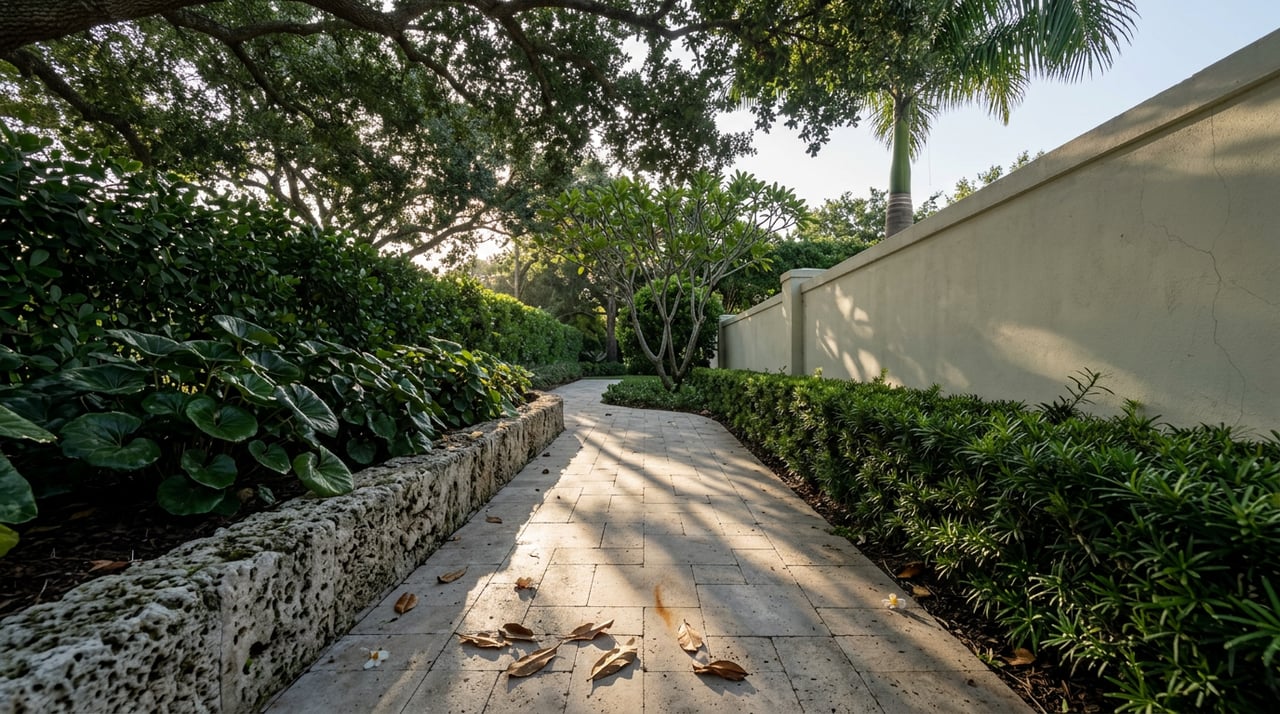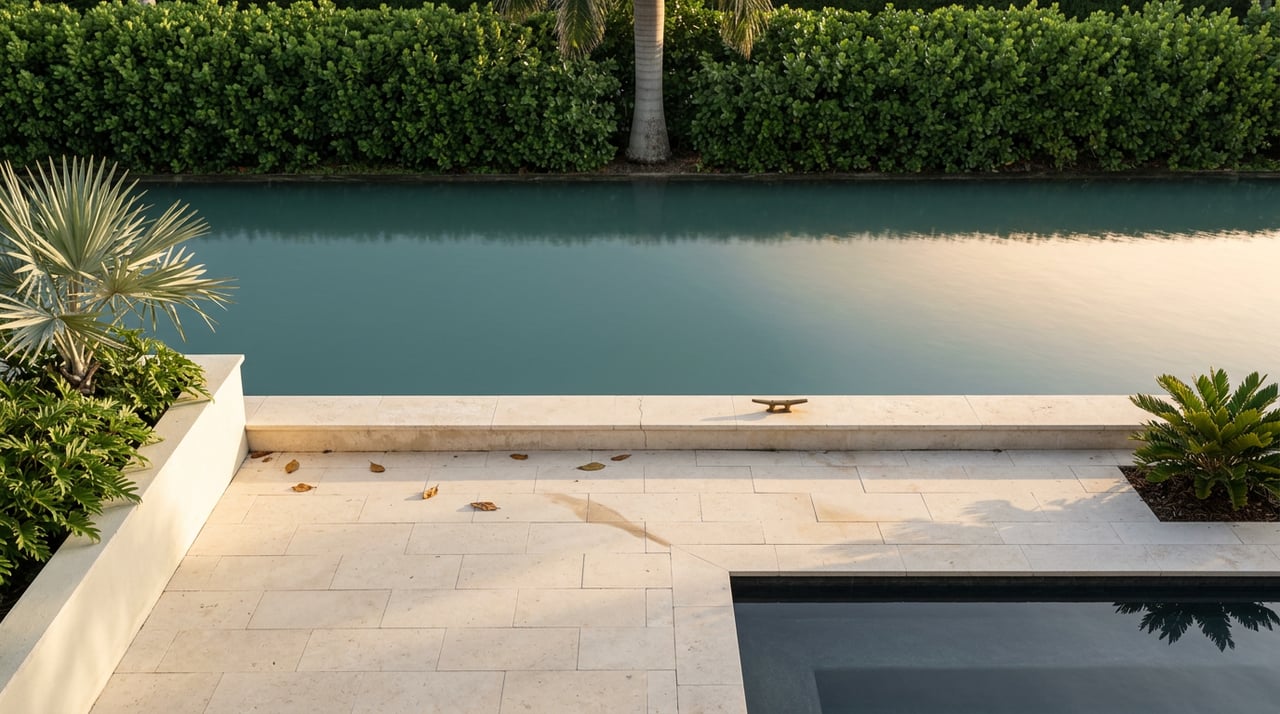
Two active listings in Gables by the Sea sit within a few hundred thousand dollars of each other this summer. One is on Lerida Street with direct ocean access and a 100-foot seawall. The other is on Coruna Avenue and carries a "Fixed Bridge" designation on its waterway. On a portal grid they look like peers. On the water they are not the same asset, and the gap between them is where most buyers lose or preserve several hundred thousand dollars of long-term value.
That gap is the reason the median price in this 360-home enclave is one of the least useful numbers in South Coral Gables.
The line that splits the market
Gables by the Sea reads on paper as a single guard-gated waterfront community bounded by Old Cutler Road, Red Road, and Biscayne Bay. In practice it is three overlapping submarkets, and the border between them is a street name rather than a price band.
- No-bridge ocean-access lots. Peninsulas and canal-front parcels south of Lugo Avenue with unobstructed passage to Biscayne Bay. This is the boater's tier and the trophy tier, running to a $28,000,000 ceiling on current inventory.
- Fixed-bridge canal lots. Waterfront addresses on interior canals where a low crossing caps the vessel that can transit to open water. Same "waterfront" tag on the portal, materially different buyer pool at resale.
- Interior lots north of Lugo. Homes inside the gates but without ocean access at all. Ernie Bascuas of Compass has noted that sale prices in this segment start around $1.5 to $2.5 million for properties that do not border the water, well below the community's headline median.
The Lugo Avenue reference is not folklore. Local market write-ups of the community are explicit that homes north of Lugo Avenue do not have ocean access, and the street terminates at a bay view that has anchored the enclave's identity since the Coral Bay Property Owners' Association was formed on March 30, 1964. The HOA was renamed the Gables by the Sea Homeowners' Association in 1989, and the two 24-hour guardhouses that define the current arrival experience were funded through a special taxing district approved by property owners in 1997.
What the headline number is hiding
The Gables by the Sea "median" that shows up on portals is not one number this year. It is at least three, and the spread between them is the story.
As of April 2026, one national portal put the median list price at $5,500,000 with 17 active houses ranging from $2,350,000 to $28,000,000, while the average sale price sat at $3,949,552 and the trailing 12-month median sale price at $3,350,000. A separate MLS-based tally through June 2026 counted 14 closings over the prior year at an average sale price of $3,066,648, a 92% list-to-sell ratio, roughly $690 per square foot, and 93 days to sell. A third source shows 14 waterfront listings at a $5.34M median and 166 days on market.
Read those together and a pattern emerges. The community sells at a healthy discipline to list price when a deal comes together, but time on market is roughly triple the national norm and the standard deviation of price is enormous. A $3M average sale coexisting with a $5.3M waterfront median means the closed transactions are being pulled by the non-waterfront and fixed-bridge tiers, while the trophy inventory sits and waits for its buyer.
The portal median is not the market. It is a weighted average of three markets that happen to share a gatehouse.
The seawall is the number buyers underprice
Listing copy in Gables by the Sea is unusually candid about seawall status, and that candor is a tell. Active inventory this cycle repeatedly highlights "100-foot reconstructed seawall," "newly rebuilt seawall (completed approximately three years ago)," "50 ft seawall," and specific draft depths such as "9-foot draft." When a feature earns that much square footage in a listing description, it is because its absence would materially reprice the property.
Two frictions sit inside that seawall line.
The first is capital expense. A full seawall reconstruction on a 50 to 100 foot canal frontage is a six-figure project, and it is one of the few improvements a Gables by the Sea buyer cannot defer without also deferring insurance and dock use. A dated seawall on a $3.5M canal home is not a $3.5M home minus cosmetic updates. It is a $3.5M home minus a seawall project the next owner will fund.
The second is bridge clearance and draft, which govern what actually leaves the dock. A property advertising a 9-foot draft on a no-bridge canal is telling a different story than a same-priced home on a fixed-bridge waterway, even if the portal filter treats them identically as "waterfront." At resale, the no-bridge, deep-draft parcel appeals to the sportfish and motoryacht buyer who drives the top of this market. The fixed-bridge parcel does not.
A framework for comparing two listings at the same price
For a buyer weighing two Gables by the Sea addresses at a similar list price, the following diligence order tends to surface value or friction before contract.
- Confirm ocean access, in writing. Ask the listing agent to specify whether the parcel has no-bridge passage to Biscayne Bay or transits a fixed bridge. Portal tags conflate the two.
- Pull seawall permit history from the City of Coral Gables. The city's permit search is public. A recent seawall permit is an asset. Its absence on an older home is a budget line to negotiate.
- Measure the canal, not the lot. Water frontage and turning basin geometry drive vessel size. A 12,000 square foot lot with 50 feet on a narrow interior canal is a different asset than a 12,000 square foot lot with 100 feet on a wide T-section.
- Check the position relative to Lugo Avenue. North of Lugo the parcel is inland and priced accordingly at resale. South of Lugo the address participates in the peninsula and bayfront tier.
- Read the year built against Coral Gables's Board of Architects standards. Tear-down redevelopment in the community is active, and older homes that cannot be economically renovated to modern standards trade as land plus seawall.
None of this is exotic. It is the diligence that separates a buyer using the portal grid from a buyer using the community's own geometry.
Where this leaves a summer 2026 buyer
Two conditions in the current cycle favor a patient, well-briefed buyer here. Days on market at 93 to 166 days depending on the tier are long enough that thoughtful offers get a hearing, and the 92% list-to-sell ratio suggests sellers are still generally realistic once a buyer engages. At the same time, the trophy tier at $19M and above has not cleared, which means the top of the market is not pulling the middle upward the way it did in 2022 and 2023.
The opportunity is not the median. It is the mispriced fixed-bridge listing that has been read as comparable to a no-bridge peer, and the older canal home whose seawall has quietly aged into a negotiation point. Both require the buyer to look at the property in the terms the community actually uses, not the terms a portal filter offers.
FAQ
Are homes north of Lugo Avenue still considered Gables by the Sea? Yes. They sit inside the gates and inside the HOA boundary, and they benefit from the same 24-hour guarded access that the special taxing district has funded since 1997. They simply do not carry ocean access, which is why local market write-ups treat them as a distinct pricing tier.
How should a buyer think about fixed-bridge canal lots? As waterfront with a specific ceiling on vessel size and, at resale, a narrower buyer pool. That is not a reason to avoid them. For a buyer whose use case is a smaller center-console or a swim dock rather than a 40-plus foot cruiser, a fixed-bridge lot can be the most efficient dollar in the community. The mistake is paying a no-bridge price for a fixed-bridge asset.
Is the community's inventory unusually dated? Construction in Gables by the Sea spans from 1957 through roughly 2018, so architectural vintage varies widely on the same block. The redevelopment cycle is active, particularly for older canal homes on premium water positions, and Coral Gables's Board of Architects governs the outcome.
If you are weighing a Gables by the Sea address against a Cocoplum, Gables Estates, or Deering Bay alternative, the community-level geometry matters more than the portal median. Andrea Diaz works with buyers on the granular questions that decide long-term value here, from seawall diligence to the practical difference between a Lugo peninsula lot and a canal-interior home at the same price. Contact Andrea for a private conversation about the tier that fits.